
 English
  العربية
 A Bundle of Heavy Suitcases

Life is a journey, whether its duration is long or short, and each of us is headed to a destination. Along the way, we carry our bags, whether their weight is light or heavy.
These are the bags of life that hold the human experience, overflowing with movement and vigour, with diligent work, joy and sadness, surging emotions, fleeting thoughts, pleasure and pain, tolerance and bigotry, justice and injustice, and good and evil.
You carry all these bags and more, whether you want to or not. The heavier they become, the more you face a difficult choice: either they will exhaust and destroy your body, or you will shed them to continue your journey and reach your destination. These are my bags of life, which I will recount briefly, perhaps combining two into one.
For every person is a direction he turns to.
Some of us are believers in God, the beloved Creator who has blessed us with the joys and hardships of life. For without hardship, we wouldn't know ease; without bitterness, we wouldn't taste honey. These are truths difficult to grasp for those with a narrow view and limited thought.
And some of us are disbelievers who don't believe in God but believe in their own limited minds, incapable of knowing the Maker. For without the Maker, there would be no creation, and nothing would come from nothing. But it is the soul and what it desires, the absolute freedom and what it chooses, and the viewpoints and what they are biased toward.
Yet, there remains one truth in which I will not differ with a believer or a disbeliever, a righteous person or a corrupt one, a learned person or an ignorant one: that absolute truth in the universe is death.
Packing My Bags
The decision to leave was unexpected. From the very first moments of the bloody military coup in Egypt, moments of terror began to seize me, spreading until they consumed my mind and ran through my blood. With every sound of a car passing by my bedroom window, I would wake up in a panic, running in a frenzy as if I were in the midst of fire. I'd peek out from behind the window, imagining the political security forces storming my house, dragging me back to the political prisons with their torture and torment. My eyes could barely close to sleep before I'd be startled by the sounds and groans of torture in the interrogation centres of a political authority that knows nothing of politics but the name, and nothing of the concepts of a state but injustice and absolute dictatorship.
In stolen moments of my life, I left my country for an Arab nation, seeking safety for myself and my family, who followed me later. But the long arm of the regime's intelligence services reached out, trying to catch us and return us to the fold of oppression.
So, the first suitcase was: A journey to the land of peace and freedom.
I thought a lot about traveling to several countries to find the peace and freedom I had been searching for since I was a child in elementary school, when I stood up against a tyrannical teacher.
I will never forget his immense height, his harsh voice, and his arrogance, and how I was that dwarf challenging the giant aggressor.
Finally, I set down my first suitcase in Sydney, Australia, the land of dreams and the dream of freedom and peace. A freedom threatened by routine and legal procedures, but the hope of obtaining it was not lost. I felt as though I had lifted this suitcase from my shoulders the day I swore the oath of allegiance to my new country and sang its national anthem. True home is the home of freedom and peace.
The Second Suitcase: A Different Culture
On the streets and in the homes of Sydney, I carried my suitcase of a different culture, with a different set of values within me. Here, the value of giving without a price is rare, and the value of generosity without a return is scarce. Life here is purely materialistic. I was determined to spread my positive culture, not caring about the looks of those around me. I'll never forget the day I helped some employees of a company carry their belongings. Their looks were strange to me, and I didn't ask them why they were so surprised. I simply let my culture prevail.
Nor will I forget the man who came to the store where I worked asking for a sandwich. I gave him my own lunch for free. He stood, hesitant to accept it, so I assured him that it was good, and he would like it. Nor the child who didn't have enough money to buy what he wanted, so I paid for it. Nor my neighbour, to whom I sold what he needed at cost. Nor the elderly woman and her husband who asked for a lemon, so I took one out of my personal bag and gave it to her for free; she took it in astonishment. Nor the girl who couldn't afford a few pills of Panadol for her headache, so I gave her some from my own supply. At first, she was scared, suspecting they weren't real, but her fear vanished after I gave her a bottle of water to take them with and showed her a head massage technique to relieve the headache. Nor the homeless man to whom I took off my own T-shirt because he was freezing. There are hundreds of situations in which I held on to my noble values as long as they were humanitarian and helpful to those around me.
The Third Suitcase: A Different Religion
In Australia, religion doesn't seem to be a visible problem. Most of the non-Middle Easterners I met were atheists. But the real problem arises when your different behaviour stems from your religion. The woman who extends her hand to shake yours and is surprised when you don't shake hands with women will be stunned. Or a female classmate who tries to hug and kiss you and you refuse because you're a Muslim. Or someone who tries to convince you to eat pork or share a glass of wine, and you refuse because you're a Muslim. A friend might even ask, "Why don't you drink alcohol?" I'd reply, "Can you drive a car while intoxicated?" He'd say, "Of course not, the law prohibits it." I'd ask, "Why?" He'd say, "Because you might not be able to control the car and could endanger your life and the lives of others." I'd tell him, "That's just when you're driving. What about all other aspects of your life? A human is a rational being, and alcohol robs him of his mind and self-control. God wants us not to expose our lives and the lives of others to a potentially dangerous experiment."
And there was my atheist friend who bought a lighter from me and asked in astonishment, "Do you really believe in the existence of a God?"
I took the lighter from his hand and said, "Where do you think this was made?" He said, "In China, of course." I replied, "Are you trying to convince me that this simple lighter was made in China, and yet you wouldn't find it by chance under your bed every day, but that this precisely made and beautifully diverse universe has no Maker?" My friend couldn't answer, and after that, he showed more respect for my Islamic rituals.
As for my neighbour, David, that kind, always-smiling neighbour who would come to me late on weekends to buy his necessities when he was drunk, he never forgot the day he pulled out a large sum of money while intoxicated and said, "Take this, it's a gift." He insisted on it and left. I put the money in an envelope, wrote his name on it, and told my friend who worked during the day, "Give this to Mr. David when he wakes up and comes here." He couldn't believe I had returned the money because he didn't even remember it. Days passed, and David was surprised to learn that I was a journalist and still wrote articles. We got to know each other better, and he learned more about the Islam that stood behind my inner peace and my peace with people. Islam is a word derived from "peace" in Arabic, and the Prophet Muhammad, peace be upon him, said, "A Muslim is one from whose tongue and hand people are safe." Days passed, and Mr. David's father came with him to meet me. I learned that he was a high-ranking government official. How happy I was when the true face of my religion; not the false one promoted by some; was revealed.
My reader friend: He was a young man full of energy, always carrying a book with him daily. I decided to get him a copy of the translation of the meanings of the Quran and a translated copy of the biography of the Prophet Muhammad. He was very happy, and a close friendship grew between us.
Alex learns Arabic: My new friend, Alex, was studying political science, and among his subjects was Arabic. He asked me to help him learn it, and I volunteered without pay. We went on trips to the museum and parks, and the discussion extended because he noticed my punctuality for prayer. He asked me, "What is this Islam?"
I replied, "Islam is a comprehensive religion, built on five interconnected parts: beliefs, manners and ethics, worship, various transactions, and laws. It is a complete guide to life—spiritual, behavioural, social, and legal."
I explained it to him briefly and drew it on his papers, which he kept. But he asked a strange question: "Isn't your prophet a prophet of war?" I said, "Before I answer you, I will ask you, is there peace without war?" He replied, "History says there is no true peace without war. You have a wise response."
I told him I'd elaborate: "Islam only fights those who fight it. In war, we do not kill or rape women; ask Berlin after the Allies took it in World War II how many women were raped and killed. We do not burn crops, destroy places of worship, or force anyone to convert to Islam. You can review the Inquisition and what happened to the Muslims in Spain."
I advised him to read the biography of the Prophet Muhammad by Karen Armstrong. My friendship with Alex lasted until he finished his studies, but I believe his perception of Islam changed.
The Visiting Marine: When it was time for prayer, I would close the glass doors of the store where I worked and pray. Some customers would wait for me to finish my prayer, and some would express their admiration for the movements of the prayer, which one of them compared to spiritual yoga. But a hotel guest, who introduced himself as a Marine, didn't like waiting for me. He approached me with a smooth, knife-like demeanour and suddenly said, "Why is Islam a religion of killing and terrorism?"
I replied, "You're right! It is the religion of terrorism that killed millions of Native Americans, killed five million in the Vietnam War, 25 million in the Second World War, ten million in the siege of Iraq, seven million in Algeria, and so on."
He withdrew, saying, "I hope to see you later, my friend." When he checked out of the hotel to end his trip, he came to say goodbye.
At the train station at midnight: My final scene ends with prayer on the platform, which held only me and a young man who stood staring at me in the cold winter air, while the refreshing scent of Sydney's harbor blew over the platforms of Circular Quay station. After I finished praying, he came to ask me, "Are you a Muslim?" He spoke with admiration that in the middle of this cold and quiet night, I was performing this prayer and asked to learn about Islam. My limited language could not meet his request, but I got his phone number and still have it. The next day, I sent him a book introducing the religion of Islam. He sent his thanks, and the scene ended.
You are in Australia, a country of religious tolerance and open discussions. Accept others, even if they accuse you, for your fingers are not all the same size.
The Fourth Suitcase: The Philosophy of Sex
Oh, what a heavy suitcase you have to carry with you to a foreign land. Sex and its practice are an inherent part of human nature. Without it, humanity and all of creation would not exist.
My Australian friend asks me, "Are you a monk? How do you enjoy your life without a girlfriend and a glass of wine? You are a strange person!"
The situation repeats itself in a practical way. A female classmate at TAFE is attracted to me and asks me to visit her at her home because she lives alone and wants a friend. But I refuse, so she says, "Are you crazy?! How do you live like this? Are you gay?"
The situation recurs even with strangers. An unknown woman asks me after work to visit her, as she lives close to my workplace, and she explicitly offers, "I want to have sex with you." I reply, "I am a Muslim, I can't touch a woman who is not my wife." She responds, "And is your wife here in Australia?" I reply, "She's in Turkey!" She leaves angrily.
Several situations like this, but what is the difference?
It is the philosophy of sex in Islam: It is a matter as sacred as prayer, not just a purely biological process. Western culture sees it as a biological process like eating, when you're hungry, you eat; when you're thirsty, you drink. Islam acknowledges this but with a regulated and disciplined philosophy. It is an act of worship like prayer, and you are rewarded by God, the Creator, in the afterlife for this discipline. This discipline extends through three stages: the stage before marriage, which emphasizes the necessity of lowering your gaze from women, controlling your desires, and directing them toward seeking a wife with the qualities of a chaste woman who, like you, has not had sex before the concept of the "virgin" who has preserved herself to join her partner. The marriage stage and the selection of a suitable wife who will be your life partner and for whom you will be responsible for providing and caring the concept of "guardianship" (qawamah). The post-marriage stage, which includes the responsibility of procreation, raising children, loyalty, fidelity, mutual love, affection, and mercy. The matter then extends to your wife being your companion in Paradise if you are good to her, or for her to ask to leave you if you are bad to her. The wife is part of a larger social structure, for she has guardians who handle her marriage and allow the new husband to enter this social structure. The matter must have a contract that is announced to the public, signalling and celebrating the birth of a new family.
It is not a fleeting one-night stand. I used to be amazed at the aimless confusion of boys and girls after these fleeting relationships. The matter has reached a point where the father is unknown, and wombs have become birth machines, not a means of bonding. I am fully aware of the individualistic tendencies, whether they are feminist or masculine, not to mention the avoidance of responsibility for a child, a home, or a wife.
I think you now understand the weight of this suitcase and the weight of the offers that the soul craves but the mind rejects. However, at the end of the term, my classmate told me, "You are a man who is faithful to your wife." (Finally, she understood).
For someone with a weak grasp of the language like me, it's difficult to explain the contents of this suitcase to those around me, and it will remain heavy as long as no one else carries it with me.
The Fifth Suitcase: The Language Suitcase
In my story in this new land, I may have enjoyed freedom, but in reality, I didn't enjoy psychological peace as I had imagined. The main reason was my weakness in language. Some might think it's an easy and simple matter six months and you'll master the language without considering individual abilities and the surrounding circumstances of the learner. Despite the government's efforts and support for language education, there will still be a learning deficit for people like me. This particular suitcase is still very heavy for several reasons. One is that the community that makes you feel comfortable will often be a community of your own language. This is why I live in the Arab areas of Western Sydney, where the feeling of alienation is reduced, and halal food, mosques, Arab grocery stores, and a community you love and that loves you are available. Although rents are expensive in these areas, they are suitable for people with weak language skills like me. The second reason is work: if you go to study, you won't work, and if you go to work and get caught up in providing for your family, you won't learn. Even the financial aid for education provided by the government is not enough for the expenses of a single person, let alone a whole family. One often tends to work with their own community and language. What's strange is that my children are fluent in three languages: Arabic, English, and Turkish. As for me, my version is old. My teacher told me, "You are so steeped in your language and attached to it, and that's why it is difficult for you to learn English as long as you think it is hard." My other teacher said, "Don't express English in Arabic; try to think and speak in English." I truly still feel the weight of the language suitcase.
The Sixth Suitcase: The Suitcase of Family Reunion
Reuniting with my family is the suitcase I live for. I will never forget the Garden of Sorrows, that first park where I sat alone, smelling the scent of my distant family, and touching their faces imprinted in my heart. When I woke from my dream, I would cry intensely and resume the course of life, full of hope that God would reunite my family so that I could talk to them and they could talk to me, and they could feel my feelings, and I could feel theirs. What a heavy suitcase it was, one that lived with me for more than four barren years, passing through heavy events. Its weight may have lessened with their arrival in the land of dreams (Australia), but the suitcase still holds responsibility, hope, fear, and a desire for the family's future, their education, and their future lives.
The Seventh Suitcase: The Suitcase of Separation
When you settle in this country, you are refreshed by its pleasant weather, the fragrance of its flowers, and the scent of its trees, and even its singing birds delight you with their sounds. But from behind these oceans, memories call out to you, you smell the scent of separation, and you feel the thorns of distance and loneliness as you toss and turn on your bed. When night comes, it brings with it the train of sorrows, and you remember those who left you at every station of life. The hardest part of this suitcase was separating from my wife before the family reunion. My whole life became darkness within darkness and were it not for my faith in God and the conviction that life is fleeting, I would have been counted among the lost from grief and sorrow. I will never forget the humane acts of those around me and their solace. I will never forget Ms. Joan, the lawyer, and what she did for my travel to my family when my wife passed away, nor her efforts in reuniting me. I will not forget my friends' support, their material and moral help, and their solace. I will not forget those outside Australia, their calls, and their condolences. The fears of this suitcase will probably remain as long as I am here.
The Eighth Suitcase: The Humanitarian Suitcase
How beautiful this suitcase is in its shape, colour, and feel, and how pleasant is its scent that delights my soul and soothes my eyes. The more I turn its pages, the more I realize the secret of these good souls and good manners, the secret of inner peace, and the happiness a person feels when their humanity touches the feelings of love and sadness in the souls of others, healing them and mending their brokenness.
Hundreds of meters away on Queen Street in Sydney, my first humanitarian feelings were in the office of Ms. Joan the lawyer. I'll never forget how she stopped my hearing when I told her what I had suffered in political prisons from torture and oppression. The translator broke down in tears, and a haze of intense emotions filled the session, which made her stop the session for a break. She returned as a professor of law and said, "I'm not supposed to be affected by your story, but it's the sincerity of human feelings."
Nor will I forget Mr. Frank, the owner of the adjacent restaurant, who brought halal chicken specially for me and would carry free sandwiches to me himself. Before closing at five, he would bring evening coffee for free, motivated only by human kindness.
And that well-mannered girl, Crystal, who worked as a barista at the adjacent restaurant and considered herself my daughter. She would send my lunch with Mr. Frank and prepare my coffee for free. When I insisted on paying, she would get angry. I can't forget how she would call my daughters, how she cried about my wife's death, and how they consoled me. And I will not forget how she collected money for my travel to my children, but I refused to take it and explained that my culture does not allow me to accept this money.
The humanitarian situations are countless because they are woven into the very fabric of the soul, making them difficult to count.
The Ninth Suitcase: The Suitcase of Companions on the Path
I lived with this suitcase during the years of loneliness and immigration, and perhaps my feet would not have touched this country were it not for it. Companions of goodness are the ones who lightened my burdens. My new friends Bilal, Amr, Ahmed, Youssef, and others are people who devoted their time and money to help me without return. They didn't fall short in anything, and the group of friends, more than 70 people, how they cared for me and smoothed over difficulties and helped me in times of hardship. They are the same group that carries the concerns of a lost country and a new, born one. Their efforts, fragrant with affection and wrapped in the cloak of brotherhood, are indescribable. Every time I touched a part of this suitcase, I was preoccupied by its richness of love and affection. You live with the companions of the path with your whole soul and body. Their joy and welcome of my family were beyond description. I lived their feelings, and they lived in my heart, and their suitcase, with its pristine white colour, still emanates a pure, sweet fragrance.
The Tenth Suitcase: The Suitcase of Work and Skills
This is the heaviest and most exhausting of the suitcases. It has lived with me and still accompanies me at all times. Between the need for money and the ability to work and earn it, the horses of skills run in a race. I cannot predict which of them I will win with, or which will break and not finish the race. I have lived with a mindset that has possessed me my entire life: the necessity of acquiring a manual skill, despite being a journalist. I worked in journalism and educational training in high schools in Egypt for nearly 20 years, and in pure journalism, writing and covering, for another 10 years. More than half of my life has been spent practicing journalism and media work; humanitarian, political, social, and educational. The profession of journalism mixed with my blood and followed me like my own skin. I see no other profession as beautiful as it. However, alongside this profession, I practiced several other supporting jobs to earn a living in Egypt, including beekeeping and trading in honey, printing and artistic binding of books and university theses, plumbing, butchery, and trading in paper and stationery. Here in Australia, I studied and learned the trade of house painting. I worked as a salesman in a convenience store and as a furniture mover, despite my painful disc issues, a serious injury to my right foot, and the lingering effects of torture in the prisons of the dictatorship. All of this did not stop me from carrying this suitcase and earning a living in the hardest ways. The weak language suitcase prevented me from getting a better job opportunity, and the culture of working without guarantees in a greedy capitalist environment prevented me from getting my full rights. I remember going to work through an agent at a company in the Flemington market for ten gruelling hours, and I haven't received my wages for more than two years. Not to mention the completely unsafe work environment in the construction sector and the prevalent "cash in hand" culture in some sectors that shortchanges you, but you are forced to accept it. I had hoped to work even as a cleaner in a newspaper or media institution, just so I could smell the scent of my beloved profession and feast my eyes on colleagues and journalists, even if I was not a partner in their work and writing. The suitcase is still heavy, and I cannot carry it, and the struggle of life continues.
The Eleventh Suitcase: The Suitcase of Fear
This is a strange and wondrous suitcase. Every time I get rid of it, I find it back among my other suitcases. Every time I empty it, it fills up completely. One of the strongest types of fear that haunted me was the fear of the police and how security officials deal with people. Although this country is governed by law, the residue of panic from the police and their raiding my home in Egypt still affects my view of police officers, and the memory of them stopping me at the airport still hurts me, as if injustice will never forget us. Were it not for the moments of relief that lessened the intensity of this fear, this suitcase would have been impossible for me to carry. I remember while I was getting my fingerprints checked the police officer in charge, who had a high rank, brought me a chair to sit on while she stood. I refused to sit! She asked, "Why?" I said, "My culture does not allow me to sit while you stand; this is not proper etiquette or respect for women." She brought another chair and sat down to help me fill out the forms. After I finished, she gave me the police phone number for citizen assistance and said, "For any situation where you need police help, call this number."
My fear is varied: fear for the future of my children and my new wife, fear of unintentionally hurting or harming others' feelings, fear of returning to my home country and seeing my beloved parents and my kind sisters, fear of securing a source of decent livelihood, and even fear of myself, that time will make me forget my values and the world will distract me from my goals, fear of new social relationships or the cooling of old social relationships that I loved and wanted to continue. It is a strange suitcase, summarized in constant caution and a calculated review of every step. This ever-renewing heavy suitcase has not yet been time to get rid of.
The Twelfth Suitcase: The Suitcase of Hope
Sometimes I carry this suitcase, and at other times I lose it. I have hope that is enough for the whole world, and then I lose it completely. That hope for a life full of mysticism, asceticism, love, affection, noble values, and hearts free of all malice. I have the spirit of a volunteer for good, a pioneer in giving, and a seeker of reconciliation among people. I love all people to a degree that makes me feel their pain and treat it. I have a hope that makes my eyes tear up for everyone I lose, and my ears rejoice for every success. My material and physical abilities may fail me in sharing with and helping others, but my prayers and supplications for them remain, that God will grant them success and remove their worries and sorrows. This is the suitcase that gets lost from me in times of calamity and when I lose loved ones. This pink suitcase, which emanates the fragrance of pure incense, I see others; my children and loved ones; carrying it, and I am filled with joy. This suitcase will continue to accompany me until I meet my Lord in the gardens of eternity, God willing.
This is a bundle of life's suitcases, stories from my life that I write so they won't be forgotten, all of them titles for an immigrant's life.
Written by:
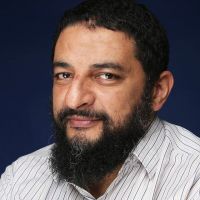
Khaled Elkady - Former Humanitarian Journalist - Sydney, Australia
Comments