 العربية
  English
 Why is Egypt’s Authoritarian Regime Afraid of a Disabled Teenager?

In authoritarian political systems, the full force of state machinery often targets the most vulnerable to send a chilling message to the broader public.
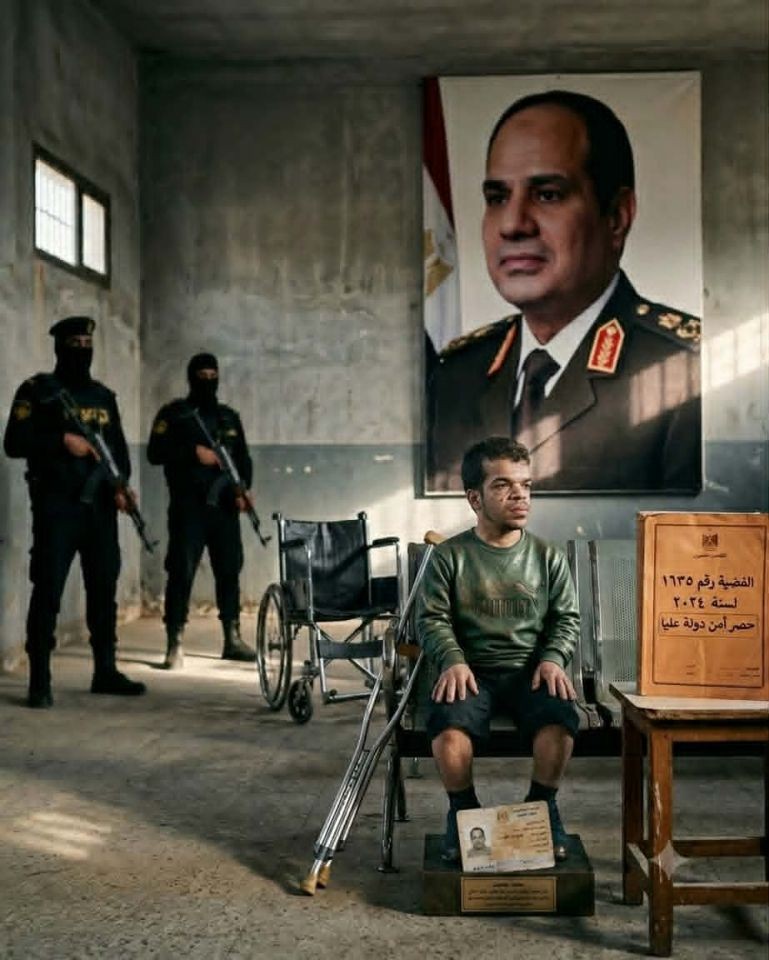
This grim reality is starkly evident in the case of Mohamed Waleed, a 19-year-old Egyptian university student born with severe, visible physical disabilities, including dwarfism and skeletal deformities that require assistance for basic daily physical needs.
Currently held in Egypt's notorious State Security detention system, Waleed faces an astonishing charge: establishing and leading a terrorist organization. For an international audience unfamiliar with the realities of modern Egypt under President Abdel Fattah el-Sisi—a military general who seized power in a 2013 coup—such an accusation defies logic.
How does a disabled teenager become a grave national security threat to a state equipped with hundreds of thousands of armed personnel, intelligence agencies, and advanced surveillance systems?
To understand this paradox, one must look beyond the individual case and examine how Egypt's state apparatus operates. Since 2013, the Sisi regime has systematically dismantled independent civil society, political opposition, and free media.
In this environment, counter-terrorism legislation is routinely weaponized to criminalize basic civic engagement, critical thinking, and social media activity.
Legal Absurdity: Charges Without Evidence Waleed's case is being handled by the Supreme State Security Prosecution (SSSP)—a specialized, extrajudicial branch of Egypt's judiciary that operates as an arm of the security services. Historically reserved for high-level threats, the SSSP is now used almost exclusively to target peaceful dissidents, journalists, human rights defenders, and everyday citizens expressing frustration online.
The prosecution charged Waleed under the country's sweeping 2015 Anti-Terrorism Law—a piece of legislation broadly condemned by United Nations experts for defining "terrorism" so vaguely that it encompasses peaceful protest and critical speech. The primary allegation accuses him of "founding and leading a terrorist group."
Under established international legal standards, proving a "leadership" role in an illegal organization requires demonstrating a physical or digital infrastructure, a chain of
command, operational logistics, and financial networks. However, case records reveal a complete absence of evidence. The prosecution's claims rely entirely on Waleed's peaceful online activities and digital posts expressing solidarity with regional human rights issues, particularly the Palestinian cause following the outbreak of the Gaza war.
In Sisi's Egypt, labeling individual social media posts or casual conversations among friends as "leading a terrorist entity" is a standard legal maneuver used to deny bail and bypass constitutional protections.
Pre-trial Detention as Extrajudicial Punishment A central mechanism of state control in Egypt is the weaponization of "pre-trial detention."
Under Egyptian law, the state can hold individuals in custody without a trial while an "investigation" is ongoing.
Although legally meant to be a temporary preventative measure, the SSSP routinely rotates detainees through standardized, assembly-line hearings, extending their detention automatically for months or years.
This practice—often referred to by rights groups as a "revolving door" system—transforms pre-trial detention into an extrajudicial prison sentence imposed without a verdict. In Waleed's case, this practice manifests in two critical ways: Denial of Medical Accommodation: Egypt's prison system is notoriously overcrowded and unsanitary.
Detention facilities consistently fail to provide necessary medical care, accessible facilities, or physical accommodations for prisoners with disabilities.
This violates basic international standards, the UN Standard Minimum Rules for the Treatment of Prisoners (Nelson Mandela Rules), and Article 81 of Egypt's own 2014 Constitution, which explicitly guarantees the rights and protection of persons with disabilities.
Holding a severely disabled youth in an unequipped, punitive environment amounts to cruel, inhuman, and degrading treatment. Procedural Delays and Isolation: Routine detention renewals are conducted via brief video link or in closed hearings where defense lawyers are denied access to official case files.
This ensures the detainee remains isolated from their family and the outside world, creating a climate of perpetual uncertainty.
Structural Fear and Regime Fragility Deploying an entire state security apparatus against a disabled student reveals a profound structural fragility at the heart of the Egyptian regime. Despite possessing absolute control over military, police, judiciary, and state media resources, the government exhibits an intense paranoia toward any unmonitored civic activity.
This deep-seated anxiety stems from two core vulnerabilities: Fear of Uncontrolled Digital Spaces: Having crushed physical protests in public squares, the regime views social media platforms as dangerous, unregulated spaces where youth can organize or share alternative narratives.
Every digital gathering, no matter how small or informal, is viewed by security agencies through the paranoid lens of a potential uprising.
Fear of Moral Exposure: Authoritarian states rely heavily on controlling the public narrative to project strength and stability. The moral clarity of individual voices—especially a young, disabled student speaking out on human rights—exposes the stark contrast between everyday state repression and official propaganda. Ultimately, Mohamed Waleed's imprisonment is not a sign of state strength, but an indictment of a regime so terrified of its own citizens that it views physical weakness and moral courage as existential threats to the throne.
References
[1] Egyptian Official Gazette, Law No. 94 of 2015 on Combating Terrorism, Issue No.
33 bis (a), August 15, 2015.
[2] Sorour, Ahmed Fathi, The Mediator in Criminal Law -
Special Part, Dar Al-Nahda Al-Arabiya, Cairo, 2018. [3] Egyptian Initiative for Personal Rights (EIPR), Report on the Supreme State Security Prosecution and Prolonged Pre-trial Detention, Cairo, 2023.
[4] Constitution of the Arab Republic of Egypt, 2014 (Amended 2019), Article 81 (Rights of Persons with Disabilities).



اشترك في الموقع لتصلك إشعارات على بريدك الإلكتروني عن المدونات الجديدة في الموقع.

تعليقات